Foundation strengthening is often the quiet half of every successful building lifting project — invisible from the street, but the part that determines whether the structure will still be standing comfortably in fifty years. Here are the modern techniques we use in the field.
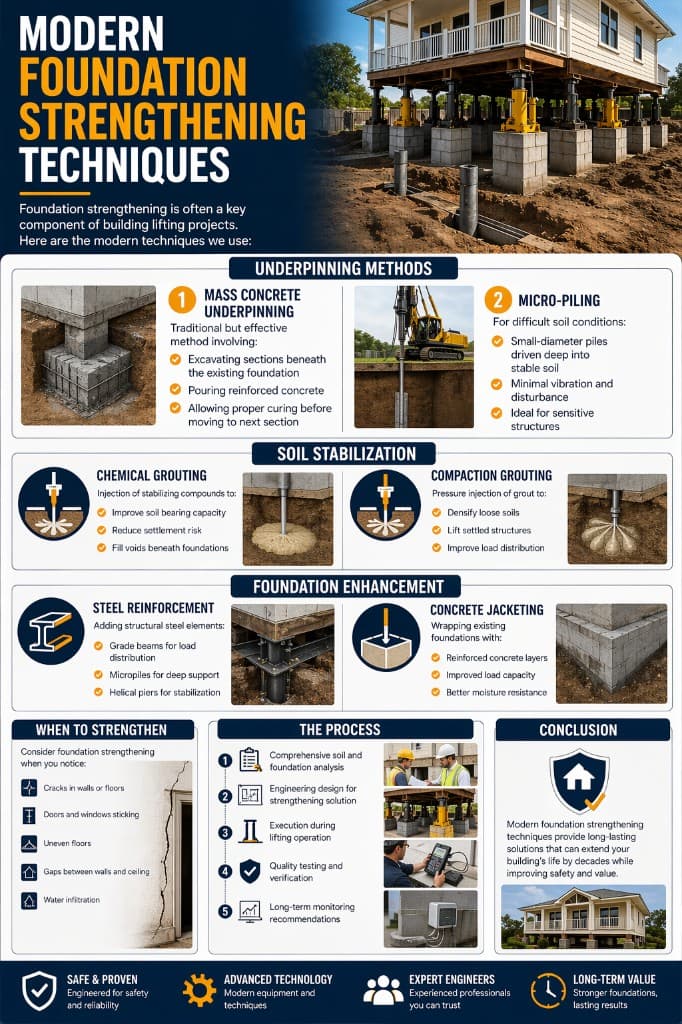
Underpinning Methods
1. Mass Concrete Underpinning
The traditional, heavily proven method. It involves:
- Excavating sections beneath the existing foundation in a controlled sequence.
- Pouring high-strength reinforced concrete into each section.
- Allowing proper curing before moving to the next section so that the load is transferred safely.
2. Micro-Piling
For difficult soil conditions, micro-piling is the modern answer:
- Small-diameter piles driven deep into stable soil layers.
- Minimal vibration and minimal site disturbance — important on tight urban sites.
- Ideal for sensitive structures, heritage buildings and properties with neighbouring construction.
Soil Stabilization
Chemical Grouting
Targeted injection of stabilizing compounds into the soil to:
- Improve soil bearing capacity in problem zones.
- Reduce future settlement risk under load.
- Fill voids and washouts beneath existing foundations.
Compaction Grouting
Pressure injection of grout to:
- Densify loose, soft soils.
- Lift settled structures back to level.
- Improve load distribution across the bearing area.
Foundation Enhancement
Steel Reinforcement
Adding structural steel elements where the original design fell short:
- Grade beams for better load distribution between columns.
- Micropiles for deep support on weak soil profiles.
- Helical piers for fast, low-disturbance stabilization.
Concrete Jacketing
Wrapping existing foundations with reinforced concrete layers to deliver:
- A meaningfully higher load capacity.
- Better long-term moisture resistance.
- A continuous, uniform bearing surface for the lifted structure.
When to Strengthen
Consider proactive foundation strengthening when you notice any of:
- Cracks in walls or floors that are growing over time.
- Doors and windows that have started sticking.
- Floors that no longer feel level under foot.
- Visible gaps between walls and the ceiling.
- Persistent water infiltration around the plinth.
The Process
The five steps we follow on every strengthening job:
- Comprehensive soil and foundation analysis with bore samples where required.
- Engineering design for the chosen strengthening solution.
- Execution during (or immediately after) the lifting operation.
- Quality testing and verification — load tests, level checks, photographic record.
- Long-term monitoring recommendations handed back to the owner.
Done right, modern foundation strengthening adds decades to the life of the building — and almost always pays for itself the first time the property changes hands.
Conclusion
Modern foundation strengthening techniques provide long-lasting, predictable solutions that can extend a building's life by decades while improving safety, comfort and resale value. The right combination — underpinning, soil stabilization, reinforcement — depends entirely on the soil, the structure and the goals of the owner. That's the conversation we have on every site visit.